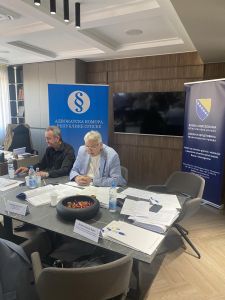
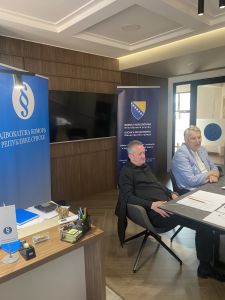
As part of the continued successful cooperation between the Ministry of Justice of Bosnia and Herzegovina, the Sector for Criminal Legal Assistance and Training in Criminal Matters before the Court of Bosnia and Herzegovina, and the Bar Association of Republika Srpska, a training session entitled “The Rights of the Injured Party in Criminal Proceedings – Divergent Court Practices in Bosnia and Herzegovina” was held at the premises of the Bar Association of Republika Srpska in Bijeljina. The training was organized within the framework of the continuous professional development programme for attorneys appearing before Departments I, II, and III of the Court of Bosnia and Herzegovina.
Following the introductory remarks by a representative of the Ministry of Justice of Bosnia and Herzegovina, the participants were also addressed by Dragana Radošević, representative of the Bar Association of Republika Srpska, who emphasized the importance of mutual cooperation and the selection of current and relevant topics, as evidenced by the large number of participants attending the training.
The training was led by distinguished attorneys Miodrag Stojanović of the Bar Association of Republika Srpska and Vlado Adamović of the Bar Association of the Federation of Bosnia and Herzegovina. A total of 37 attorneys attended the training.
Through an overview of legal solutions and different approaches to the topic, the trainers raised numerous issues concerning the position of the injured party in criminal proceedings, with particular emphasis on the differing legal solutions within the legislation of Bosnia and Herzegovina. It was noted that the position of injured parties had, to a certain extent, been marginalized in procedural terms through the amendments to the Criminal Procedure Code of Bosnia and Herzegovina introduced in 2003. It was further emphasized that the most recent amendments to the Criminal Procedure Code of Republika Srpska have brought certain improvements, although significant differences still exist compared to other legal frameworks in Bosnia and Herzegovina.
Particular attention was devoted to the provisions of Articles 46a and 46b of the Criminal Procedure Code of Republika Srpska, as well as to the legal institute of the injured party acting as a prosecutor, including the conditions under which an injured party may assume criminal prosecution and the procedure for making decisions in this regard.
During the training, discussions were also held on the proactive role of the injured party during the investigation and the main trial, the right to file appeals, and the distinction between the concepts of a victim and an injured party. Participants had the opportunity to exchange views on issues relating to the imposition of sanctions, property claims, the initiation of proceedings upon a complaint, and ex officio prosecution.
Additional topics included the right to refuse testimony in cases of domestic violence, and participants were introduced to relevant European directives and convention standards concerning the protection of the rights of injured persons.
The lectures were supplemented with examples of case law and final court judgments, while participants actively contributed to the discussions by sharing their own practical experiences.
The interactive exchange of opinions and experiences between the trainers and participants further contributed to the quality and success of the training.