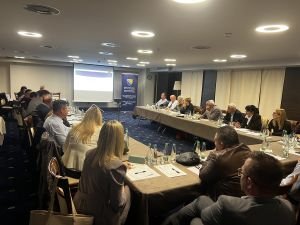
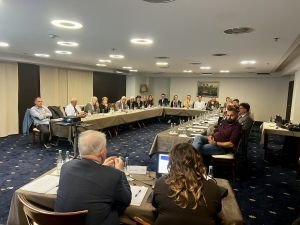
On 13 October 2026, the Ministry of Justice of Bosnia and Herzegovina, Department for Legal Aid and Training in Criminal Matters before the Court of Bosnia and Herzegovina, held a training session in Sarajevo at Hotel Europe, located at 5 Vladislava Skarića Street. The training was organized as part of the continuing professional development of attorneys-at-law under the title “Challenges and Obstacles in the Collection and Presentation of Evidence in War Crimes Cases.” It focused on evidentiary and procedural issues arising in such cases, with particular emphasis on the legality and reliability of evidence and the protection of the rights of the defence.
The training was delivered by Marijana Čobović, Prosecutor at the Prosecutor’s Office of Bosnia and Herzegovina, and Asim Crnalić, Attorney-at-Law and member of the Bar Association of the Federation of Bosnia and Herzegovina.
In her presentation, Prosecutor Marijana Čobović addressed the challenges involved in collecting evidence in war crimes cases, with particular emphasis on the passage of time and the availability of witnesses, the acquisition of wartime documentation, and international cooperation. A special part of her presentation focused on witness protection and procedural safeguards as important aspects of conducting evidentiary proceedings.
Prosecutor Čobović subsequently discussed the presentation of evidence from the prosecution’s perspective, including linking evidence to the allegations set out in the indictment, examining witnesses and expert witnesses, and presenting documentary evidence. The presentation also covered the use of materials from the Hague proceedings and the assessment of inconsistencies in the evidence.
In his presentation, Attorney-at-Law Asim Crnalić addressed the legality of evidence and the rights of the defence, with particular emphasis on access to case files and the principle of equality of arms, the use of wartime records and police reports, and unlawful evidence and defence objections in the case law of the Court of Bosnia and Herzegovina.
Particular attention was devoted to the reliability of evidence and individual criminal responsibility, including the use of prior statements and the right to examine witnesses, identification evidence, circumstantial evidence, and expert testimony. In this context, the admissibility of statements obtained during investigations in the Alukić and Hirkić cases was also examined.
Attorney-at-Law Asim Crnalić’s presentation provided an opportunity for constructive discussion with participants and an exchange of practical experiences, further enhancing the quality of the training and promoting an interactive approach to the subject matter.
The training enabled participants to examine the key challenges involved in collecting, presenting, and assessing evidence in war crimes cases through an overview of procedural issues and examples from judicial practice. It also highlighted the importance of respecting the rights of the defence and ensuring fair trial proceedings.
A total of 25 attorneys-at-law from across Bosnia and Herzegovina attended the training session.