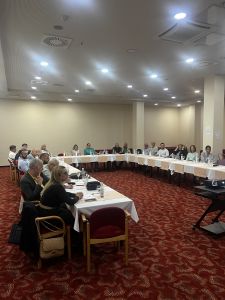
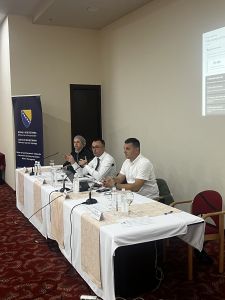
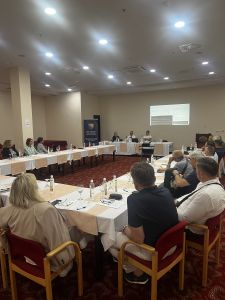
The Ministry of Justice of Bosnia and Herzegovina, through its Sector for Criminal Assistance and Education in Criminal Matters before the Court of Bosnia and Herzegovina, organized a training session entitled “Challenges and Dilemmas in the Use of Polygraph Examinations in Criminal Proceedings in Bosnia and Herzegovina” on 2 July 2026 in Zenica. The event brought together 26 legal professionals from across Bosnia and Herzegovina.
The training was delivered by Dr. Aleksandar Faladžić, Head of the Investigation and Witness Protection Department of the Prosecutor’s Office of Bosnia and Herzegovina, and Dr. Darko Soldat, Prosecutor and Deputy Head of the Department for Economic Crime and Corruption of the Canton Sarajevo Prosecutor’s Office. Through theoretical presentations, practical examples, and analyses of professional experience, the lecturers presented the role of polygraph examinations in modern criminal investigations, as well as the challenges associated with their use in Bosnia and Herzegovina.
Particular attention was devoted to the legal status of polygraph examinations in criminal proceedings, their evidentiary value, procedural limitations, and their significance during the criminal investigation phase and in directing investigative activities. Participants had the opportunity to become familiar with the scientific foundations of polygraph testing, examination methodologies, factors that may affect test results, as well as international experience and contemporary developments in this field.
Through an open and engaging discussion, participants examined numerous practical issues and dilemmas encountered by attorneys, prosecutors, police officers, expert witnesses, and other participants in criminal proceedings. The exchange of professional experiences between the lecturers and participants further enhanced the quality of the training and provided an opportunity to consider the topic from various professional perspectives.
The training once again confirmed the importance of continuous professional development and an interdisciplinary approach to understanding modern investigative methods. The knowledge gained and the exchange of experiences contributed to the more effective application of legal and professional standards in everyday professional practice.