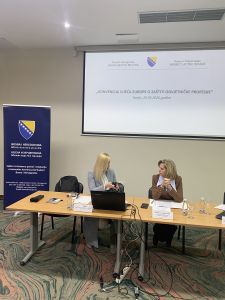
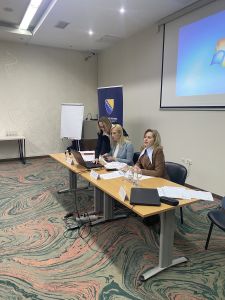
The Ministry of Justice of Bosnia and Herzegovina, Sector for Criminal Assistance and Education in Criminal Matters before the Court of BiH organized and conducted, on March 26, 2026, an educational session titled “Council of Europe Convention on the Protection of the Legal Profession”.
The training was held in Konjic at Hotel Garden, with the participation of 15 attendees.
On behalf of the organizer, Prof. Dr. Sanela Latić, Assistant Minister at the Ministry of Justice of Bosnia and Herzegovina, addressed the participants with an opening speech, explaining the entire process of participation of Bosnia and Herzegovina and the Ministry of Justice from the moment the Council of Europe announced its intention to draft the aforementioned Convention, up to its signing by the Minister of Justice of BiH, highlighting that the ratification procedure is currently underway. She also emphasized that the legal nature of the Convention, as a multilateral international treaty, is binding for Bosnia and Herzegovina, and that cooperation between the Ministry of Justice and the legal professional community will continue in the implementation of the Convention.
The session was officially opened and all participants were welcomed, while the program, structured through defined sessions, was led by attorney at the Bar Association of the Federation of BiH, Tanja Hadžagić.
The lecturer, attorney at the Bar Association of the Federation of BiH, Tanja Hodžić, presented the main topic through four sessions, introducing participants to all provisions of the Convention. She emphasized that lawyers are often subjected to threats, significant media criticism, and public pressure, all of which are clearly addressed and prohibited by the Convention, noting that the Convention has received support from lawyers not only across Europe but worldwide.
Special attention was given to the key principle of protecting communication between lawyer and client, as well as Article 8 of the European Convention on Human Rights in relation to proportionality and data confidentiality.
The lecturer highlighted that the Convention, as the first legally binding instrument of its kind, represents a tool in the hands of lawyers for strengthening the legal profession, which is a fundamental pillar of an independent judiciary.
Particular focus was also placed on Article 5 of the Convention regarding the obligations of the state concerning the rights and modalities of practicing the legal profession.
The discussion among participants was particularly stimulated by the topic of cost schedules and their application, as well as issues related to court decisions in this regard.
The training was conducted in a highly interactive atmosphere, resulting in a quality exchange of opinions and experiences, a certain analysis of laws in practice, their application leading to inequality of arms between lawyers and prosecutors, and highlighting the need for involving lawyers in working groups during the drafting of legislation.