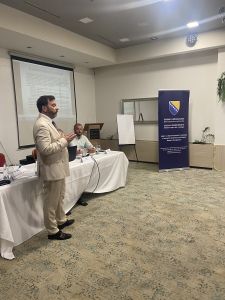
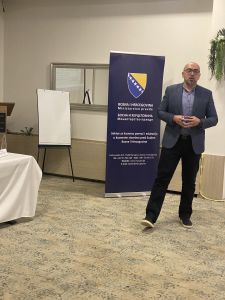
The Ministry of Justice of Bosnia and Herzegovina, Sector for Criminal Legal Assistance and Training in Criminal Matters before the Court of Bosnia and Herzegovina, organized a training entitled “Special Investigative Measures” on 12 May 2026 in Bihać.
On behalf of the organizer, the training was opened by Boris Jukić, Head of the Department for Training in Criminal Matters before the Court of Bosnia and Herzegovina, who addressed the participants and emphasized the importance of continuous professional development for judicial office holders and attorneys in the field of criminal law and criminal procedure. He particularly highlighted the challenge of applying special investigative measures in terms of finding a balance between the need for the effective prosecution of the most serious criminal offences, on the one hand, and the protection of the right to privacy and other fundamental human rights, on the other.
The training programme was attended by 16 attorneys, and the lectures and professional sessions were led by Adnan Tulić, Prosecutor at the Una-Sana Canton Prosecutor’s Office, and Jasmin Abdagić, attorney and member of the Bar Association of the Federation of Bosnia and Herzegovina.
During the training, participants were thoroughly introduced to the concept and types of special investigative measures, the subject matter of proof, facts that do not require proof, as well as the fundamental principles that must be respected when implementing special investigative measures. Particular emphasis was placed on the legality of conducting special investigative measures and the protection of fundamental human rights throughout their implementation.
Through a practical and interactive approach, issues relating to the implementation of special investigative measures were addressed step by step, including procedures for conducting evidentiary actions prior to the issuance of an order to initiate an investigation, as well as the submission of requests for the implementation of special investigative measures by prosecutors and law enforcement authorities.
The trainers particularly emphasized the importance of the investigator’s role as a key factor in the successful implementation of special investigative measures. They also examined issues related to the corroboration and comparison of data, the boundaries between lawful conduct and entrapment, and challenges concerning the very initiation of special investigative measures.
Through presentations enriched with practical examples, photographs, and analyses of domestic and European case law, participants were introduced to the standards of the European Court of Human Rights, particularly in the context of Articles 6 and 8 of the European Convention on Human Rights and Fundamental Freedoms.
The training was conducted in a highly interactive atmosphere, with active participation from attendees through discussion, exchange of experiences, and analysis of specific practical cases, further confirming the significant interest of the professional community in the topic covered.