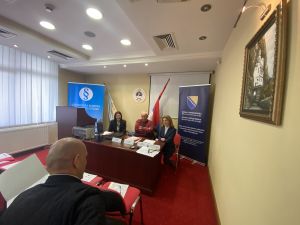
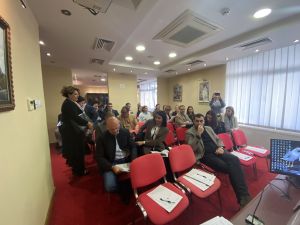
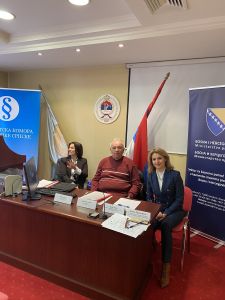
The Ministry of Justice of Bosnia and Herzegovina, Sector for Criminal Assistance and Education in Criminal Matters before the Court of BiH, in cooperation with the Bar Association of Republika Srpska, on March 24, 2026, in Banja Luka, at the premises of the Bar Association of Republika Srpska, held an educational session as part of the continuous professional training of attorneys, titled “Rights of Suspects and Accused Persons in Criminal Proceedings, with Reference to the Right of Defense”.
The training was conducted by lecturers Nikolina Ševa, District Public Prosecutor at the District Public Prosecutor’s Office in Banja Luka, and Nebojša Pantić, attorney at the Bar Association of Republika Srpska.
The training, attended by 28 participants, was opened on behalf of the Bar Association of Republika Srpska by Sonja Malić, President of the Education Commission of the Bar Association of Republika Srpska.
Following the introduction of the lecturers and participants, the lecturers began their presentations in accordance with the agenda, starting with the basic rights of suspects in line with Article 3 of the Criminal Code of Republika Srpska, emphasizing that these rights are divided into three categories.
All rights were addressed, with particular emphasis on the right to the presumption of innocence of suspects/accused persons, highlighting that this presumption must be respected by all parties in the proceedings until proven otherwise, including the media and political actors. Article 6 of the European Convention on Human Rights was also emphasized, as it encompasses all the rights of suspects during criminal proceedings (judgment of the European Court of Human Rights in the case of Salduz v. Turkey).
The issue of inequality of arms was highlighted in relation to the rights of suspects/accused persons during the investigation phase, as they are not granted access to case files, nor the right to appeal during investigations conducted by the prosecution, with the defense only gaining the position to obtain evidence and undertake procedural actions after the indictment is confirmed.
Special attention was given to the specific set of rights of persons deprived of liberty and the moment when they are informed of their rights, particularly in the case of foreign nationals.
During the training, the right of defense of suspects/accused persons after the filing of the indictment was addressed as a broad area, with detailed discussion on Article 241, paragraphs (4) and (5) of the Criminal Procedure Code of Republika Srpska, highlighting shortcomings in the law regarding objections to the indictment.
A comprehensive set of legal provisions related to the conduct of the main trial was also covered.
Through their thorough and professional presentation of the topic, as well as an interactive approach in working with participants, the lecturers delivered an exceptionally high-quality and informative training session.